

It’s the most impossible choice in marketing: Trust the fast dashboard and risk bias, or trust the lagging model and risk irrelevance. But what if you didn’t have to choose between speed and rigor? With PlatformSense marketers now have a third option; an agile MMM that delivers daily intelligence without sacrificing econometric rigor, delivering 24-hour agility to drive decisions.
Key Takeaways:
Weekly MMMs can give a false sense of speed. Frequently re-estimating with sliding windows actually means new information is diluted, and there’s always a built-in 7–14 day lag before new signals are reflected.
Speed and rigor can coexist. PlatformSense separates the long-term baseline from daily updates, so the model remains causal and refreshes every 24 hours.
A 7-day delay on a $2M reallocation is P&L risk, not a small miss. Daily agility closes the gap between dashboard and model.
Executive Summary
The market moves in hours, but traditional MMMs still live in quarters. They are built on a foundational assumption that media effectiveness is constant across time. Digital reality tells a very different story; creative fatigue sets in, competitors spend shifts, and platform algorithms are constantly updating. Every time the market moves and your model stays still, the gap between what you know and what is happening compounds silently.
Re-estimating a model every week sounds like progress. It is NOT. When you use sliding windows to generate weekly updates. Even at weekly cadence, a structural 7–14 day lag persists. Worse, the averaging effect actively smooths over the very signals that demand the fastest response.
PlatformSense is an architectural innovation that fixes this gap delivering unified marketing measurement. The long-term econometric baseline built on 1 – 3 years of data remains firmly anchored. On top of this foundation, PlatformSense applies daily effectiveness modifiers derived from real-time platform signals (CTR, Conversion Rate, Impression Share). The result is a system that provides daily MMM updates reflecting the market conditions in near real-time while retaining the full causal validity of a long-term econometric model. Speed and rigor, in one!
What You’ll Learn
Why “traditional MMMs” and modern weekly MMMs with sliding windows fail to catch the signal until the opportunity has already passed.vv
Re-estimating models weekly dilutes fresh signals and averages out the fresh signals, thus drowning any real-time adjustments made
Real-world applications where 24-hour agility and real-time marketing measurement can help marketers capitalize on flash sales, detect creative fatigue, and prevent wasted spend before it compounds.
How this connects to the broader LiftLab platform, delivering a complete system for real-time marketing measurement and marketing ROI optimization.
The Problem: The Trap of “Modern” Weekly MMMs
We all know the quarterly model is widely acknowledged as too slow for today’s marketing environment. It delivers a backward-looking analysis; a record of what happened, not a guide for what to do next. In response, the industry moved toward weekly re-estimation as a more responsive solution. But there is a structural flaw in that approach that rarely gets discussed even among leading marketing analytics tools.
Frequent remodels use sliding data windows i.e. time-dependent co-efficients to reflect evolving performance such as creative updates or competition shifts. When you re-estimate a model weekly using a sliding window, you are essentially shrinking your field of vision. Re-estimation is based on averaging the effect over the sliding time window, which means that even if you re-estimate the model with one new day of fresh data, it gets diluted by historic data, limiting your insights. You get a model that looks responsive, but in reality the model is slow to respond to real-time signals, and any changes you make are drowned amidst the noise
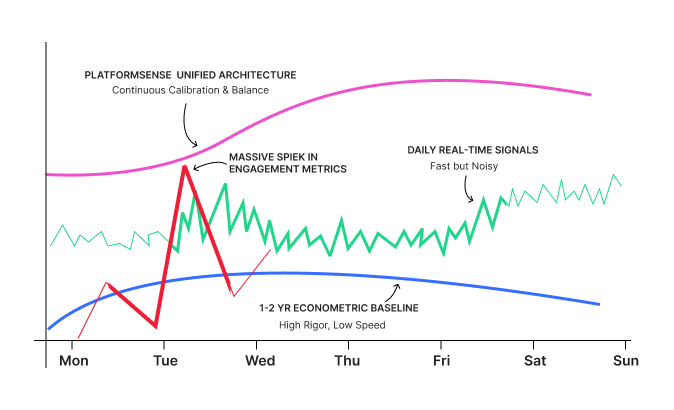
The result is a dangerous illusion of speed. Even with weekly updates, you are operating with a 7-14 day structural lag. Because the window relies on averaging, a sharp competitor move on Tuesday gets diluted by Monday’s calm and Wednesday’s noise. You don’t see the spike until the average catches up, by which time, your competitor has already won the week.
Why It Happens: Diluted Signals and Chasing Noise
The result is a dangerous illusion of speed. Even with weekly updates, you are operating with a 7-14 day structural lag. Because the window relies on averaging, a sharp competitor move on Tuesday gets diluted by Monday’s calm and Wednesday’s noise. You don’t see the spike until the average catches up, by which time, your competitor has already won the week.
This creates the “Tuesday Morning Dilemma.” Your platform dashboard shows a massive spike in CTR. Your gut says “go.” But your model says “wait.” If you wait for the model to confirm the signal, you miss the window. If you ignore the model, you lose causal rigor. Most marketing analytics tools force this trade-off, with no clear path through it.
At the scale of eight-figure media budgets, this isn’t just an annoyance; it’s a liability. A 7-day blind spot on a $2M channel reallocation isn’t just a rounding error. It’s a material risk to the P&L. You are effectively making million-dollar decisions with one-eye closed. Lack of proper budget planning can lead to wasted ad spends, that will only compound with time.
The Need for PlatformSense

Traditional MMMs
Re-estimate quarterly, creating a 90-day lag between market changes and model updates.

Modern MMMs
Re-estimate every 7 – 14 days or even daily, however, built on sliding time windows where real-time signals are susceptible to noise from historic data.

Real-time Dashboards
Respond instantly but the causal foundation that makes MMMs, valuable.
How to Fix It: Bridging the Gap with PlatformSense
The solution required us to break a fundamental rule of traditional econometrics: that elasticity must be constant. We realized that to get both speed and rigor, we had to separate them. This architecture is what makes automated MMM operationally viable at scale.
PlatformSense splits the problem in two. First, we build the stable base model on 1-3 years of data. This captures the deep, slow-moving truths about how your brand grows. It’s the “base” of your marketing mix. Then, we layer on the “agility” – daily effectiveness modifiers derived from real-time platform signals.
The system then ingests platform-level effectiveness signals such as Click-Through Rate (creative health), Conversion Rate (audience quality), and Impression Share (auction pressure) every single day. These flow directly through the MMM data pipeline, translating raw platform activity into structured daily inputs that help marketers identify the pulse of the market, and enable them to steer campaigns in the right direction.
These time-varying effectiveness modifiers are bounded. Guardrails are built in, not to limit sensitivity, but to prevent overreaction to a single day’s tracking anomaly or an isolated traffic spike. The model adjusts only when evidence accumulates consistently. This gives you the confidence to tell your CFO, “We aren’t just reacting to a dashboard blip. The model now reflects a new reality.”
PlatformSense: How it Works?
STABLE BASE
1 – 3 Years of Data
Long-term elasticity curves
DAILY MODIFIERS
CTR
Conversion Rate
Impression Share
Updated in Real-Time
DAILY RECOMMEDATIONS
Casually Rigorous
Responsive
Impression Share
Updated in Real-Time
In Action: 24-Hour Agility for Modern Marketers
High-Velocity Promotions
Black Friday. Prime Day. The holiday rush. These aren’t weeks; they are 48-hour wars. PlatformSense detects efficiency changes at the daily level. If one creative variant breaks out on Day 1, you see it. You can double up your spends while the event is still live, capturing the demand that your competitors are still trying to analyze, enabling you to capitalize on the window of opportunity, instead of seeing it after it has passed. This is a critical component of successful marketing scenario planning.
Creative Fatigue Detection
Creative doesn’t die instantly; it fades. The decline often starts around Day 7. Weekly averages mask this slow bleed until it’s a deep wound. PlatformSense tracks the curve daily. You can rotate in fresh assets the moment performance dips, maintaining peak efficiency without the guessing game.
Event-Driven Demand
Sometimes you get an unexpected opportunity; a viral moment, a PR hit, a cultural wave. Search volume spikes. Conversion rates jump. PlatformSense enables you to identify this elevated baseline immediately. You can uncap budgets with confidence, knowing you’re capturing incremental demand, not just wasting spend on existing customers, making it the perfect tool for marketing ROI optimization.
Delivering 24-Hour Agility for Marketers
Decision Checklist: Is Your Measurement Keeping Pace?
The Reallocation Test
When you shift 15% of your spend to a new channel, how long does it take for your model to validate the move? If the answer is “>7 days,” you are driving with a lag.The Isolation Test
Can your model tell the difference between “bad creative” and “competitive shift”? Or does it lump them into one generic “performance drop”? If you can’t diagnose, you can’t fix.The Monday Morning Test
When you walk into the office on Monday, are your budget decisions based on what happened yesterday, or what happened three weeks ago? The gap between those two dates is where inefficiency hides.The Causality Test
Are you pacing daily spend based on platform ROAS (biased) or marginal ROI (causal)? If your budget planning and allocation decision are driven primarily by ‘gut-instinct’ post corroborating information from your MMM and platform, there’s a serious flaw that needs to be addressed.Model Refresh Frequency
Does your current MMM use sliding windows that average out your daily performance changes? If so, it’s averaging away the volatility that determines actual efficiency.
If you find your current setup lacking, it may be because you are relying on open source mmm tools for marketing measurement that lack the real-time layer necessary for modern performance.
Frequently Asked Questions
How is PlatformSense different from weekly MMMs? Isn’t this using “time-dependent coefficients” like everyone else?
No, and the distinction matters. Time-dependent models re-estimate the curve using a sliding window. As the window slides, old data falls off, and the new data ingested averages out against the historic data, making the model forgetful and noisy. PlatformSense keeps the long-term curve (stability) and applies a modifier (speed). We don’t sacrifice statistical confidence to get responsiveness. We get both.
Does this replace the need for incrementality testing?
Not at all. Think of them as partners. PlatformSense handles the “now” – the real-time variance of daily execution. Incrementality testing handles the “truth”- calibrating the foundational Agile Marketing Mix Model (AMM). Experiments verify the model. These components work together in a unified Trust Engine.
What specific daily metrics does PlatformSense use?
PlatformSense ingests real-time platform-level effectiveness signals such as Click-Through Rate (CTR), Conversion Rate, and Impression Share to instantly detect changes in ad relevance, customer response, and competitor spend shifts. This varies from channel to channel, enabling marketers to derive key insights specific to a particular channel.
Do I need a massive data science team to run this?
No. The complexity is under the hood. PlatformSense ingests the data you already have – CTR, Impression Share, Revenue. While some open source mmm tools involve heavy complexity, LiftLab is designed to be an operational tool for marketers, not just a research project for data scientists.